
The Fed Turned Gravity Back On, Investors Continue to Float

“So I’ll meet you at the bottom, if there really is one
They always told me “When you hit it, you’ll know it”
But I’ve been falling so long, it’s like gravity’s gone
And I’m just floating,” Drive by Truckers

Interest rates fell steadily for decades. They were completely turned off between 2009 and 2021. Housing values soared. Cryptocurrency was created. GameStop “mooned.” Over the past year and a half, the Federal Funds Rate quickly rose from 0% to 5%+. Gravity has been turned back on, yet investors are still floating.

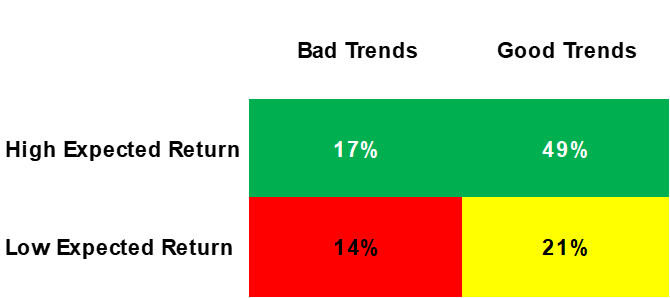
Stock market values remain elevated and continue to defy the bears, while the trends remain solidly positive. At times like this, I am glad I turned over my investment allocation decisions to an algorithm. My head wants to exit the US stock market entirely, my heart wants full exposure, our algorithm splits the difference with a 50% allocation. The other 50% earns 5%+ in risk-free US Treasuries.

Source MKAM ETF

We currently remain in the yellow zone for markets, where investors can still participate, but should proceed with caution. The market was in the yellow zone 21% of the time in the modern post Greenspan era, according to our model. The trends remain 100% solid, while expected returns are below what we require to take the extra risk to be found in the stock market. This period does stand out from the past 15 years, however. Now, we can earn real interest while we wait for expected stock market returns to improve. We want to avoid entering the red zone when serious market drawdowns occur. We are not there yet, but we will keep you posted when we enter dangerous territory.

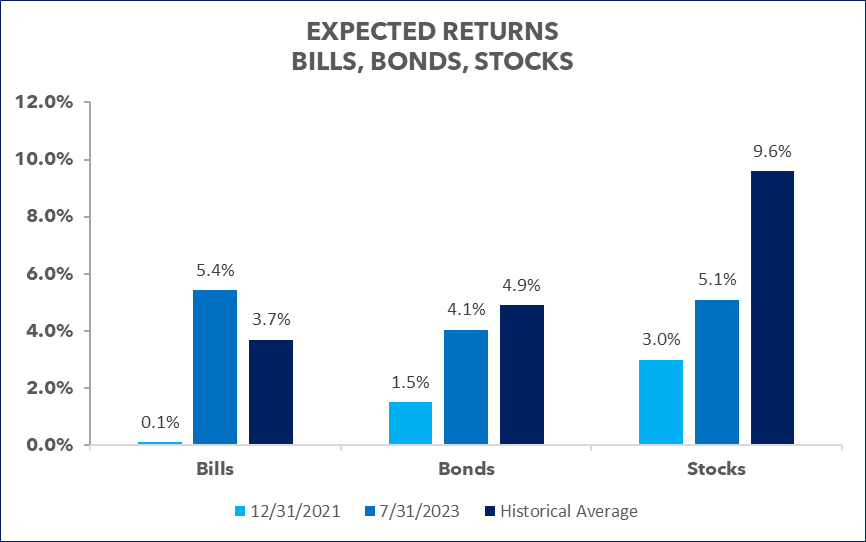
The US stock market remains too expensive according to all models with demonstrated predictive power. While US Treasury Bills now offer significantly more than their historical average and US Treasury bonds are about 20% shy of their long time average, stocks remain poised to deliver half of their historical returns. Yet, the stock market’s prospective standard deviation remains the same at 17% with higher odds of a large drawdown.

Source: MKAM ETF

Why would investors be content to accept mediocre stock returns when they can get the same guaranteed returns from the US Government in short-term bonds? We can strain to come up with some logical explanations. But we believe the best answer is simply inertia and emotions. It is very hard to sit out of a raging bull market that has been outperforming expectations for nearly 15 years. Each time the market falters, like falling 30%+ in Covid, and then recovers, it encourages investors to take more risk.

We imagine in time rationality will kick in and more investors will realize that we have left the world of ZIRP (zero interest rate policy) and TINA (there is no alternative) behind. That we are once again in a world of real interest rates, and gravity. After all, recently, the Bank of England surprised markets with a half  point increase in their benchmark rate. And the Fed keeps telling everyone who will listen they intend to keep rates higher for longer.

When will the market switch from prioritizing emotions to rationality? Or switch from optimism to pessimism? We don’t have to wonder or worry. Every day, we simply check our algorithm.

Keep Me Informed

Please enter your email address to be notified of new content, including market commentary and special updates.

Thank you for your interest in the MKAM Funds.

100% Spam-free. No list sharing. No solicitations. Opt-out anytime with one click.

Untitled

Important Information

The Fund’s investment objectives, risks, charges and expenses must be considered carefully before investing. This and other important information is contained in the prospectus, which may be obtained by following the links Prospectus and Summary Prospectus or by calling  +1.202.331.3400. Please read the prospectus carefully before investing. Investments involve risk. Principal loss is possible. The Fund is actively-managed and is subject to the risk that the strategy may not produce the intended results. The Fund is new and has a limited operating history to evaluate. Listed below are the principal risks associated with investing in the fund. For a full listing of associated risks, please consult the prospectus. Derivatives Risk. A derivative is any financial instrument whose value is based on, and determined by, another asset, rate or index (e.g., stock options). Unfavorable changes in the value of the reference asset, rate or index may cause sudden losses. Counterparty Risk. Counterparty risk is the risk that a counterparty to a financial instrument held by the Fund or by a special purpose or structured vehicle invested in by the Fund may become insolvent or otherwise fail to perform its obligations, and the Fund may obtain no or limited recovery of its investment, and any recovery may be significantly delayed. Exchange listed options, including FLEX Options, are issued and guaranteed for settlement by the Options Clearing Corporation (“OCC”). The Fund’s investments are at risk that the OCC will be unable or unwilling to perform its obligations under the option contract terms. In the unlikely event that the OCC becomes insolvent or is otherwise unable to meet its settlement obligations, the Fund could suffer significant losses. Leverage Risk. Leverage risk refers to the potential for increased volatility and losses in a portfolio due to the use of derivatives or other financial instruments that may magnify gains and losses beyond the initial investment. The Fund will utilize derivatives, such as options, to gain exposure to certain assets or markets with a smaller initial investment. New Fund Risk. The Fund is a recently organized investment company with no operating history. As a result, prospective investors have no track record or history on which to base their investment decision. There can be no assurance that the Fund will grow to or maintain an economically viable size.
Foreign Investment Risk. Returns on investments in foreign securities could be more volatile than, or trail the returns on U.S. securities. Investments in or exposures to foreign securities are subject to special risks, including risks associated with foreign securities generally, including differences in information available about issuers of securities and investor protection standards applicable in other jurisdictions; capital controls risks, including the risk of a foreign jurisdiction imposing restrictions on the ability to repatriate or transfer currency or other assets; currency risks; political, diplomatic and economic risks; regulatory risks; and foreign market and trading risks, including the costs of trading and risks of settlement in foreign jurisdictions.
Emerging Markets Risk. Many emerging market countries have a history of, and continue to experience serious, and potentially continuing, economic and political problems. Stock markets in many emerging market countries are relatively small, expensive to trade in and generally have higher risks than those in developed markets. Securities in emerging markets also may be less liquid than those in developed markets and foreigners are often limited in their ability to invest in, and withdraw assets from, these markets. Additional restrictions may be imposed under other conditions.
Depositary Receipts Risk. The risks of investment in depositary receipts are substantially similar to the risks of investing directly in foreign securities. In addition, depositary receipts may not track the price of or may be less liquid than their underlying foreign securities, and the value of depositary receipts may change materially at times when the U.S. markets are not open for trading.
Gender Diversity Risk. The returns on a portfolio of securities that excludes companies that are not gender diverse may underperform the returns on a portfolio of securities that includes companies that are not gender diverse. Investing only in a portfolio of securities that are gender diverse may affect the Fund’s exposure to certain types of investments and may adversely impact the Fund’s performance depending on whether such investments are in or out of favor in the market.
Non-Diversification Risk. Because the Fund is non-diversified, it may be more sensitive to economic, business, political or other changes affecting individual issuers or investments than a diversified fund, which may result in greater fluctuation in the value of the Shares and greater risk of loss.
ETFs may trade at a premium or discount to their net asset value. ETF shares may only be redeemed at NAV by authorized participants in large creation units. There can be no guarantee that an active trading market for shares will exist. The trading of shares may incur brokerage. This material has been distributed for informational purposes only and should not be considered as investment advice or a recommendation of any particular security, strategy or investment product. We make no representation or warranty as to the accuracy or completeness of the information contained herein including third-party data sources. The views expressed are as of the publication date and subject to change at any time. No part of this material may be reproduced in any form, or referred to in any other publication without express written permission. References to other funds should not to be interpreted as an offer or recommendation of these securities. The Fund is distributed by Quasar Distributors, LLC. The fund’s investment advisor is Empowered Funds, LLC, which is doing business as ETF Architect.
© Copyright 2012 – 2025 | Home | Advisor Home | Privacy Policy | Contact Us |  All Rights Reserved