
A Smoother Ride

Well I’m accustomed to a smooth ride
Or maybe I’m a dog who’s lost it’sbite
I don’t expect to be treated like a fool no more
I don’t expect to sleep through the night
Some people say a lie’s a lie’s a lie
But I say why
Why deny the obvious child?
-Paul Simon, “Obvious Child”

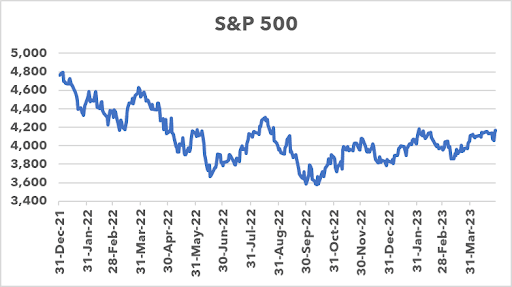
The S&P 500[1] reached an all-time high of 4,793 on December 29, 2021. Soon after the market achieved this milestone, the Federal Reserve began their well-telegraphed program of raising interest rates. While the Fed attempted to end their Great Financial Crisis induced zero interest rate policy (ZIRP) in 2018, only to relinquish as markets deteriorated quickly, this time their hand was forced by the first serious inflation in 40 years.


Source: US Treasury

The stock market fell as a result. At one point, the market was down by -25%. After a somewhat sustained market rally, the stock market closed -13% below its all-time high on 4/28/2023.

Source: S&P Global

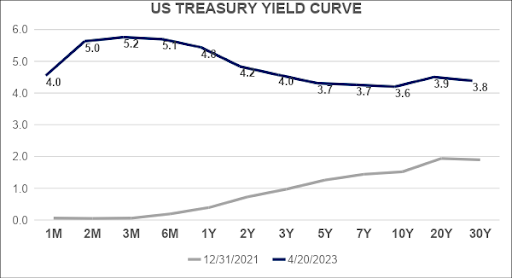
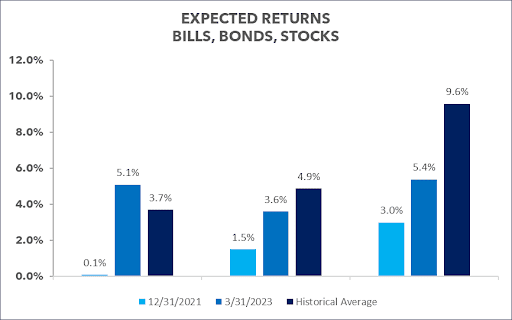
After the Federal Reserve raised the Federal Funds rate from 0% at the end of 2021, to 5% today, Treasury Bills are the one asset class currently offering expected returns greater than their historical averages. While an investor in US-Treasury Bills historically earned 3.7% per year, today they can receive 5.2% for lending their money to the US Government for 3 months. The downward sloping yield curve is the bond market’s vote that the Fed has overdone it and the economy cannot stay healthy with a 5% risk-free rate. The 10-Year US Treasury yield sits at 3.4% compared to a historical average of 4.9%. Still below average, but materially better than the paltry 1.5% on 12/31/2021. That financial institutions like Silicon Valley Bank rushed in to earn 1.5% instead of waiting for 3.6% was a big reason why they went bust. They weren’t the only ones who grew impatient.

Source: “Triumph of the Optimists”, Dimson and Marsh; US Treasury; Vanguard

Similarly, expected returns in the stock market have improved markedly, but remain well below historical averages. After generating returns above historical averages for the past 7-to-10 years, the market stands poised to generate below average returns over the next decade.
There are two ways that 5.4% can get back to the historically observed 10% return. Firstly, earnings growth can simply outpace S&P 500 price appreciation to the point that the price on the market is eventually justified by the fundamentals. Or, the market can take a significant downturn to get much cheaper quickly. For example, if the S&P 500 fell by approximately -30% before the end of the year, the expected return would rise to the historical average. How likely is it that the market would fall by 30% versus slowly growing into its current, inflated price? The stock market fell by that much or more in the DotCom Crash of 2001; the Great Financial Crisis of 2008; and the Covid crash of 2020. The ending of 13 years of ZIRP seems equally momentous.
We don’t know for certain which path the market will take to start to offer higher returns. Or, even if it ever will. Butwe do know that the risk that it will fall by an unacceptable amount for our investors remains above average.
Investors maintaining half of their normal stock market exposure makes sense to us. Being able to generate 5% in US Treasuries with virtually no risk and almost no volatility is superior to us than attempting to earn the same in the stock market with much higher volatility.The stock market’s optimism disagrees with the pessimism of the bond market. We are inclined to believe the bond market. But we are not doctrinaires. We are open to the idea that the stock market is correct. Consequently, it makes sense to maintain some exposure to the stock market, especially when that exposure is governed by trend. Historically, trend following has done a good job of getting out of the market early during pronounced corrections.
It is historically unusual that you can receive the same expected returns in 3-month US Treasury Bills as you can in the S&P 500. We do not expect this situation to last for very long. Until then, it’s wise for investors to tread carefully. And demand greater returns for taking more risk.

[1] Standard and Poor’s 500 (S&P 500) is an index of the 500 largest U.S. public companies. It measures companies’ size by their market capitalization.

Keep Me Informed

Please enter your email address to be notified of new content, including market commentary and special updates.

Thank you for your interest in the MKAM Funds.

100% Spam-free. No list sharing. No solicitations. Opt-out anytime with one click.

Untitled

Important Information

The Fund’s investment objectives, risks, charges and expenses must be considered carefully before investing. This and other important information is contained in the prospectus, which may be obtained by following the links Prospectus and Summary Prospectus or by calling  +1.202.331.3400. Please read the prospectus carefully before investing. Investments involve risk. Principal loss is possible. The Fund is actively-managed and is subject to the risk that the strategy may not produce the intended results. The Fund is new and has a limited operating history to evaluate. Listed below are the principal risks associated with investing in the fund. For a full listing of associated risks, please consult the prospectus. Derivatives Risk. A derivative is any financial instrument whose value is based on, and determined by, another asset, rate or index (e.g., stock options). Unfavorable changes in the value of the reference asset, rate or index may cause sudden losses. Counterparty Risk. Counterparty risk is the risk that a counterparty to a financial instrument held by the Fund or by a special purpose or structured vehicle invested in by the Fund may become insolvent or otherwise fail to perform its obligations, and the Fund may obtain no or limited recovery of its investment, and any recovery may be significantly delayed. Exchange listed options, including FLEX Options, are issued and guaranteed for settlement by the Options Clearing Corporation (“OCC”). The Fund’s investments are at risk that the OCC will be unable or unwilling to perform its obligations under the option contract terms. In the unlikely event that the OCC becomes insolvent or is otherwise unable to meet its settlement obligations, the Fund could suffer significant losses. Leverage Risk. Leverage risk refers to the potential for increased volatility and losses in a portfolio due to the use of derivatives or other financial instruments that may magnify gains and losses beyond the initial investment. The Fund will utilize derivatives, such as options, to gain exposure to certain assets or markets with a smaller initial investment. New Fund Risk. The Fund is a recently organized investment company with no operating history. As a result, prospective investors have no track record or history on which to base their investment decision. There can be no assurance that the Fund will grow to or maintain an economically viable size.
Foreign Investment Risk. Returns on investments in foreign securities could be more volatile than, or trail the returns on U.S. securities. Investments in or exposures to foreign securities are subject to special risks, including risks associated with foreign securities generally, including differences in information available about issuers of securities and investor protection standards applicable in other jurisdictions; capital controls risks, including the risk of a foreign jurisdiction imposing restrictions on the ability to repatriate or transfer currency or other assets; currency risks; political, diplomatic and economic risks; regulatory risks; and foreign market and trading risks, including the costs of trading and risks of settlement in foreign jurisdictions.
Emerging Markets Risk. Many emerging market countries have a history of, and continue to experience serious, and potentially continuing, economic and political problems. Stock markets in many emerging market countries are relatively small, expensive to trade in and generally have higher risks than those in developed markets. Securities in emerging markets also may be less liquid than those in developed markets and foreigners are often limited in their ability to invest in, and withdraw assets from, these markets. Additional restrictions may be imposed under other conditions.
Depositary Receipts Risk. The risks of investment in depositary receipts are substantially similar to the risks of investing directly in foreign securities. In addition, depositary receipts may not track the price of or may be less liquid than their underlying foreign securities, and the value of depositary receipts may change materially at times when the U.S. markets are not open for trading.
Gender Diversity Risk. The returns on a portfolio of securities that excludes companies that are not gender diverse may underperform the returns on a portfolio of securities that includes companies that are not gender diverse. Investing only in a portfolio of securities that are gender diverse may affect the Fund’s exposure to certain types of investments and may adversely impact the Fund’s performance depending on whether such investments are in or out of favor in the market.
Non-Diversification Risk. Because the Fund is non-diversified, it may be more sensitive to economic, business, political or other changes affecting individual issuers or investments than a diversified fund, which may result in greater fluctuation in the value of the Shares and greater risk of loss.
ETFs may trade at a premium or discount to their net asset value. ETF shares may only be redeemed at NAV by authorized participants in large creation units. There can be no guarantee that an active trading market for shares will exist. The trading of shares may incur brokerage. This material has been distributed for informational purposes only and should not be considered as investment advice or a recommendation of any particular security, strategy or investment product. We make no representation or warranty as to the accuracy or completeness of the information contained herein including third-party data sources. The views expressed are as of the publication date and subject to change at any time. No part of this material may be reproduced in any form, or referred to in any other publication without express written permission. References to other funds should not to be interpreted as an offer or recommendation of these securities. The Fund is distributed by Quasar Distributors, LLC. The fund’s investment advisor is Empowered Funds, LLC, which is doing business as ETF Architect.
© Copyright 2012 – 2025 | Home | Advisor Home | Privacy Policy | Contact Us |  All Rights Reserved